Europe’s Quiet Growth Engine: How Central & Eastern European Cities Became Economic Leaders
For decades, Europe’s economic growth narrative was dominated by Western capitals such as London, Paris, Amsterdam, or Berlin. Yet long-term data tells a different story - one that increasingly points toward Central & Eastern Europe (CEE) as a key driver of sustainable urban growth.
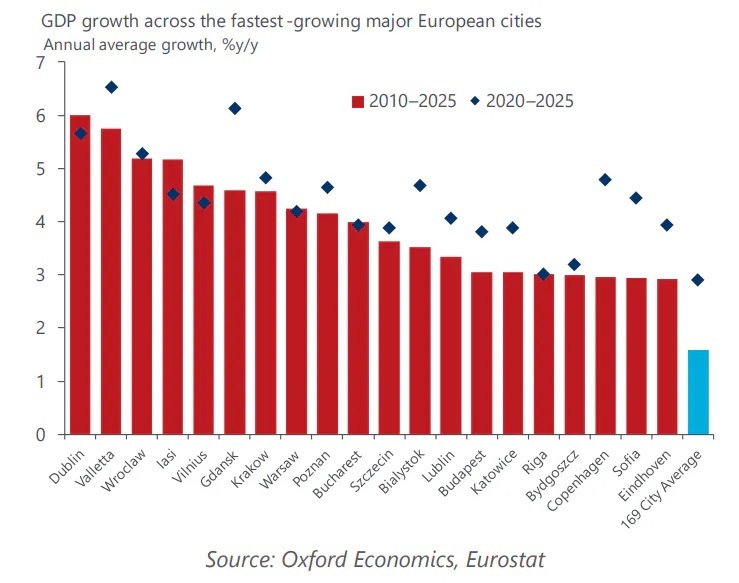
According to a comprehensive study by Oxford Economics, many of Europe’s fastest-growing major cities between 2010 and 2025 were not located in Western Europe. Instead, they were concentrated in CEE - a region that has quietly built a powerful growth model based on services, technology, and productivity gains rather than population expansion alone.
CEE Cities Among Europe’s Fastest-Growing Urban Economies
Oxford Economics analyzed real GDP growth (inflation-adjusted) across 169 major European cities over a 15-year period.
The findings were striking:
- Only four cities from Western Europe appeared in the top 20 fastest-growing cities.
- The majority came from Central & Eastern Europe, including cities in Poland, Lithuania, Romania, and the Baltics.
- Cities such as Wrocław, Vilnius, Iași, Gdańsk, Kraków, Warsaw, Poznań, and Szczecin consistently outperformed many larger Western European metropolitan areas.
Importantly, this growth was not limited to capital cities. Second-tier and regional cities played a crucial role - a key indicator of structural strength rather than isolated success.
Why Central & Eastern Europe Grew Faster
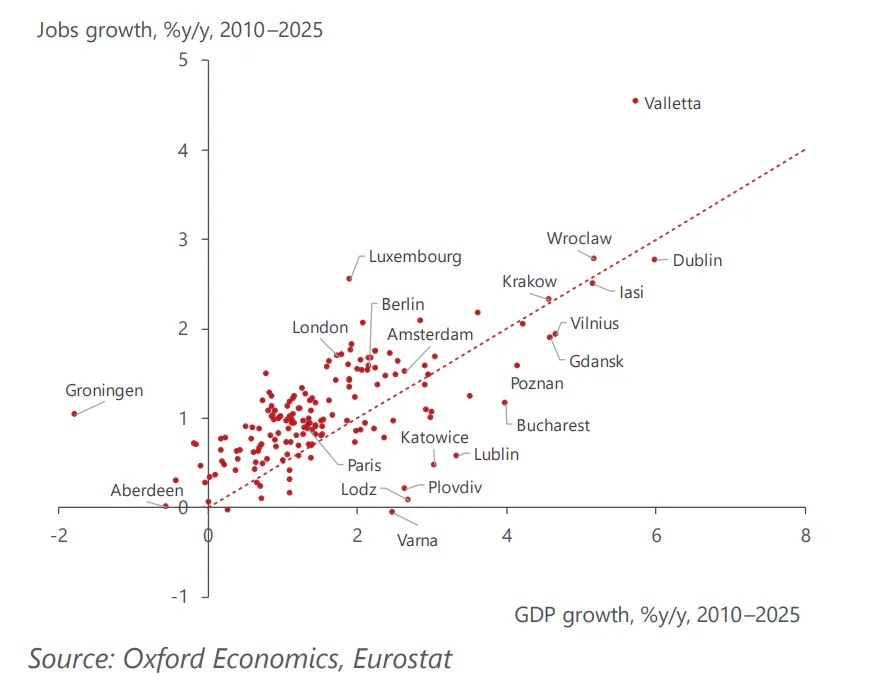
At first glance, faster growth in CEE cities might seem like a natural consequence of overall national economic convergence with Western Europe. However, Oxford Economics emphasizes that this explanation is incomplete.
In many countries, GDP growth is either heavily concentrated in one metropolitan area or evenly dispersed without strong urban hubs. CEE followed a different path.
The defining factor was sectoral structure.
Between 2010 and 2025, growth in most high-performing CEE cities was driven primarily by business services, including:
- technology and software development,
- IT outsourcing and digital services,
- finance, accounting, and professional services,
- shared service centers and business process outsourcing.
These sectors expanded across multiple cities, not just capitals - allowing growth to be distributed, resilient, and scalable.
Technology and Services as the Core Growth Engine
Oxford Economics highlights that business services were the first or second largest contributor to GDP growth in 19 of the 20 fastest-growing cities during the analyzed period.
This matters for two reasons:
1. Services - especially technology-enabled ones - scale through productivity, not just employment.
2. They integrate local cities into global value chains, making growth less dependent on domestic demand.
In cities like Gdańsk, Warsaw, Wrocław, Vilnius, and Iași, technology and digital services complemented other sectors such as logistics or tourism, creating diversified urban economies rather than single-industry dependencies.
Poland’s Strong Representation - Within a Broader Regional Trend
Poland stood out numerically, with 10 cities appearing among the 20 fastest-growing European cities between 2010 and 2025.
However, Oxford Economics’ data makes it clear that Poland’s performance was part of a wider regional pattern, not an exception.
CEE cities across multiple countries benefited from similar structural advantages:
- integration into EU markets,
- competitive service sectors,
- strong technical and professional talent pools,
- growing specialization in technology-driven services.
Romania’s Iași, Lithuania’s Vilnius, and later Estonia’s Tallinn confirm that growth momentum was shared across the region.
What the Next 15 Years Will Look Like
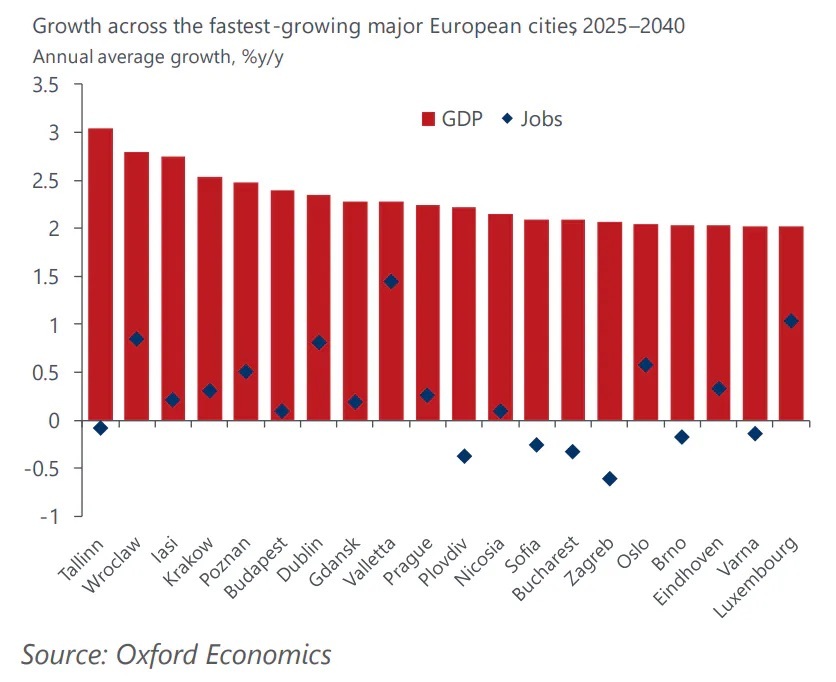
Projections for 2025–2040 suggest that growth rates across European cities will gradually converge.
Fewer cities will dominate rankings as dramatically as before, but:
CEE cities will remain among Europe’s strongest performers,
- differences between Western and Eastern Europe will narrow,
- growth will become more balanced and structurally mature.
Cities such as Tallinn, Wrocław, Kraków, Poznań, and Gdańsk are expected to continue outperforming many peers - albeit at more sustainable rates.
This transition reflects maturity, not decline.
How Central & Eastern Europe Is Redrawing Europe’s Economic Map
The rise of CEE cities represents one of Europe’s most important long-term economic shifts.
Rather than replacing Western Europe, the region has:
- diversified Europe’s growth engines,
- reduced over-concentration in a few global cities,
- created a network of competitive, service-driven urban economies.
Technology, digital services, and professional expertise have become the common foundation linking cities from Tallinn to Bucharest.
A Structural Success Story - Not a Short-Term Boom
The Oxford Economics analysis does not describe a temporary catch-up phase. It describes a structural transformation.
Central & Eastern Europe’s cities demonstrated that sustainable growth can be built on:
- productivity improvements,
- technology-enabled services,
- distributed urban development,
- integration into global business ecosystems.
As Europe faces demographic pressure and slower labor force growth, the CEE model offers lessons that are increasingly relevant for the entire continent.
Sources
Oxford Economics, Eurostat
(Real GDP and employment growth analysis for 169 major European cities, 2010–2025; projections to 2040)